

- Overview
- Specifications
- Feature Detail
- FAQ
- Recommended Products
Parameters
Chinese UV Printer, Factory Direct: A4 Flatbed for Cases, Gifts and Short Runs
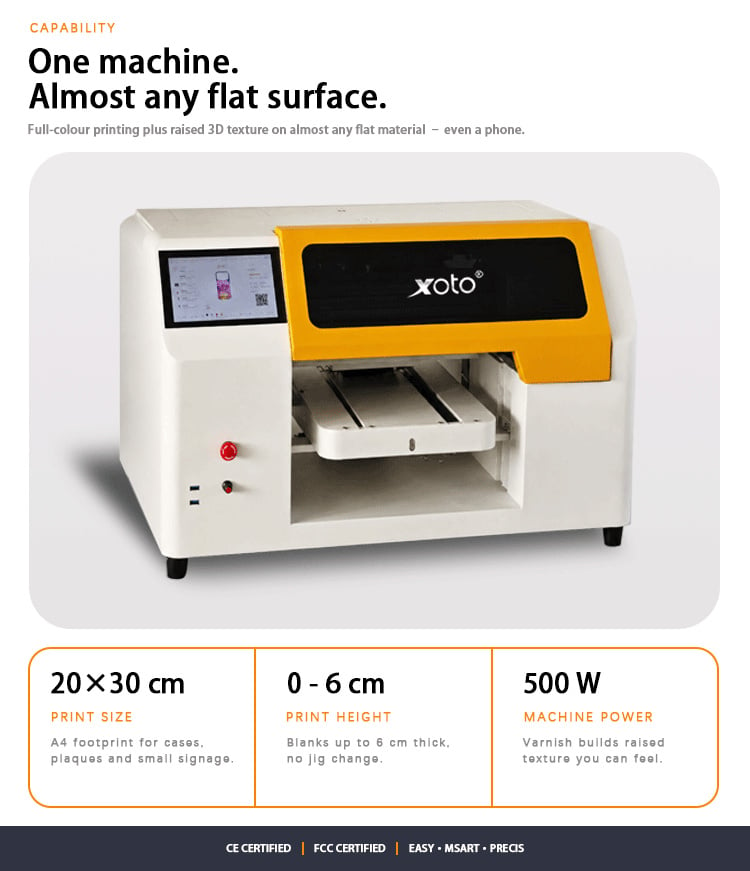
20 x 30 cm print area, 0–6 cm height, CMYK + white + varnish in one head — 500 W from a standard wall socket.
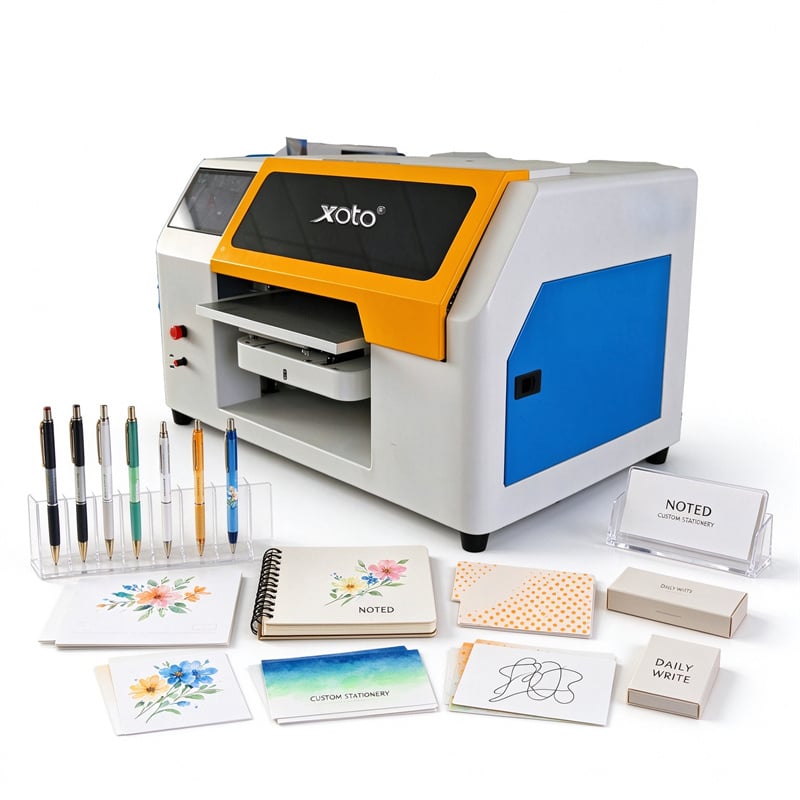
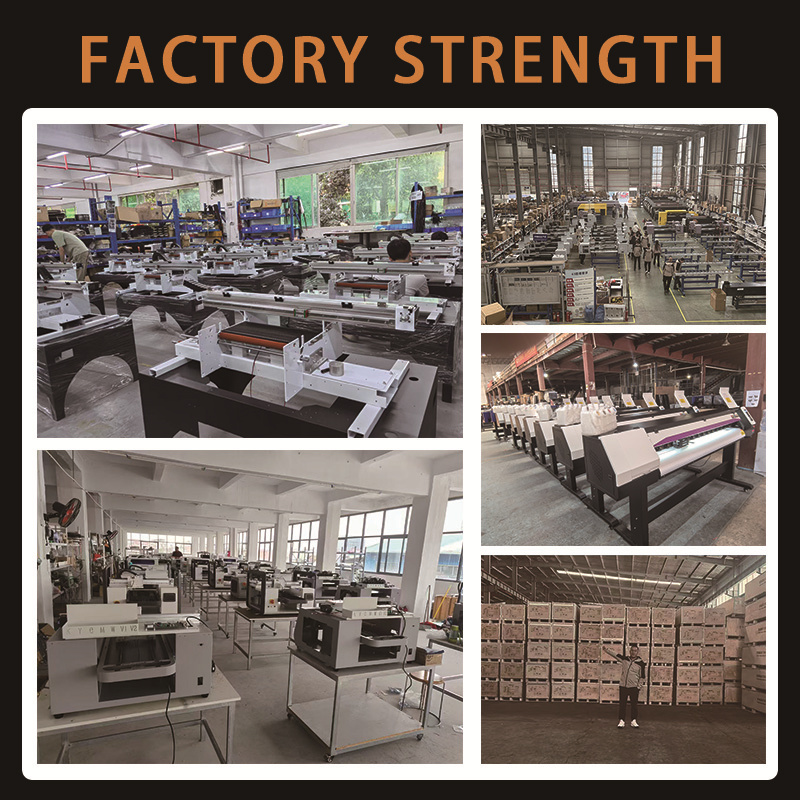
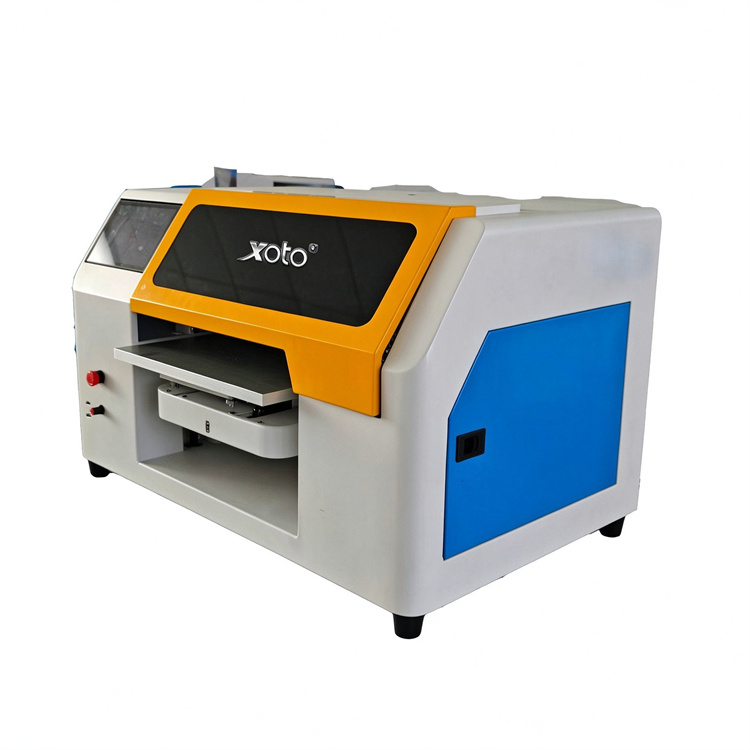
Buyers search for a "chinese uv printer" for one of two reasons: they want factory pricing instead of distributor markup, or they have been burned by a no-name unit and want to know what is actually inside the box. This page answers both. The XOTO A4 flatbed prints a 20 x 30 cm area, lifts to 6 cm for thick blanks, lays colour, white and varnish from a single Epson head, and ships CE and FCC certified at 40 kg net — small enough to air freight, serious enough to run daily.
It is also the least intimidating UV printer we make. There is no computer, no RIP station and no design software to learn: scan the QR code on the touchscreen, pick an image on your phone, place the blank on the bed, press print. That workflow is why this class of Chinese UV printer has become the default entry point for phone-case kiosks, gift shops and small print studios.
Why Buyers Pick This Chinese UV Printer
• Factory-direct supply — you buy from the people who build it, so head replacement, spare parts and technical answers come from the same place.
• A4 20 x 30 cm bed — the standard size for phone cases, plaques, keychains, badges and small signage; no oversize machine for undersize work.
• 0–6 cm print height — blanks up to 6 cm thick go in without a jig change, which covers mugs, boxes, power banks and small assembled items.
• CMYK + white + varnish in one head — white base for dark and clear substrates, plus varnish that builds raised 3D relief up to 6 mm.
• 2–4 m²/h output — realistic small-batch throughput, not a headline number measured on a test pattern.
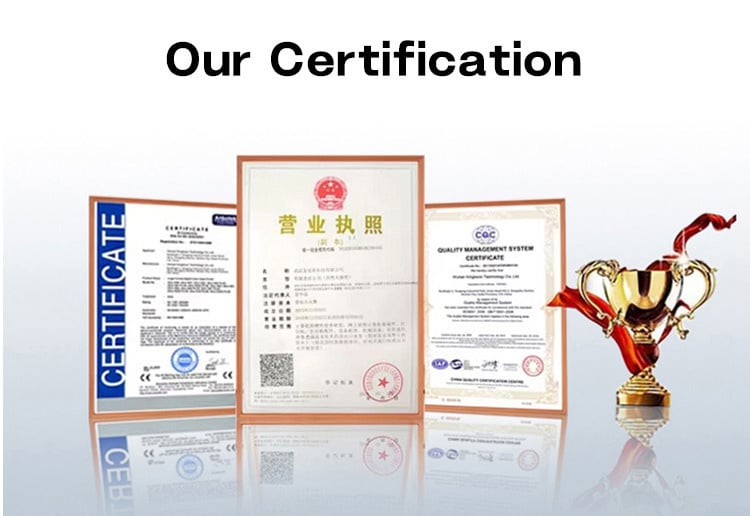
• CE and FCC certified — documentation you can hand to a customs broker, a landlord or a client.
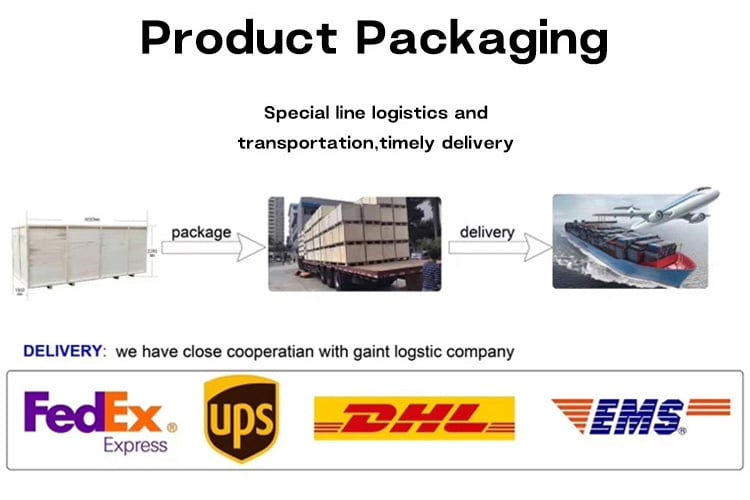
• 40 kg net, 60 kg gross — ships in one 80 x 60 x 55 cm crate by air or LCL, no container required.
• Phone operated — iOS, Android, Windows and Linux; scan, pick, print from the screen or a handset.
Specifications
| Print head | Epson DX7 / I3200HD | Print media | Any flat material |
| Print head qty | 1 | Print size | 20 × 30 cm |
| Print speed | 2 – 4 m²/h | Print height | 0 – 6 cm |
| Colour | CMYK + White + Varnish | 3D relief | Up to 6 mm |
| Ink type | UV embossing ink | Software | Wellprint |
| System | iOS / Android /Win / Linux | Voltage | 110 / 220 V,50 – 60 Hz |
| Power | 500 W | Machine size | 72 × 50 × 42 cm |
| Packing size | 80 × 60 × 55 cm | Weight | 40 kg net /60 kg gross |
| Standard configuration | 1 print head, CMYK + white + varnish, suction platform | ||
| 8 ink channelsCMYK, white and varnish in one head. | A4 bed20 × 30 cm, up to 6 cm thick. |
| Phone operatedScan the code, pick, print. | Net weight: 40 kgOne crate, 80 × 60 × 55 cm. |
Specification sheet as published for the XOTO A4 UV flatbed.
| Item | Specification | Item | Specification |
| Print head | Epson DX7 / i3200HD | Print head qty | 1 |
| Print size | 20 x 30 cm (A4) | Print height | 0 – 6 cm |
| Print speed | 2 – 4 m²/h | Colour | CMYK + White + Varnish |
| Ink type | UV embossing ink | 3D relief | Up to 6 mm |
| Print media | Any flat material | Software | Wellprint |
| System | iOS / Android / Win / Linux | Voltage | 110 / 220 V, 50–60 Hz |
| Power | 500 W | Machine size | 72 x 50 x 42 cm |
| Packing size | 80 x 60 x 55 cm | Weight | 40 kg net / 60 kg gross |
| Standard configuration | 1 print head, CMYK + white + varnish, suction platform | Ink channels | 8 (CMYK, white and varnish in one head) |
| Certification | CE, FCC | Control | Touchscreen + phone app |
* Specifications follow the published XOTO A4 datasheet. Print speed depends on pass mode and coverage; the 2–4 m²/h range refers to standard production settings, not a single-pass test pattern.
What a Chinese UV Printer This Size Actually Prints
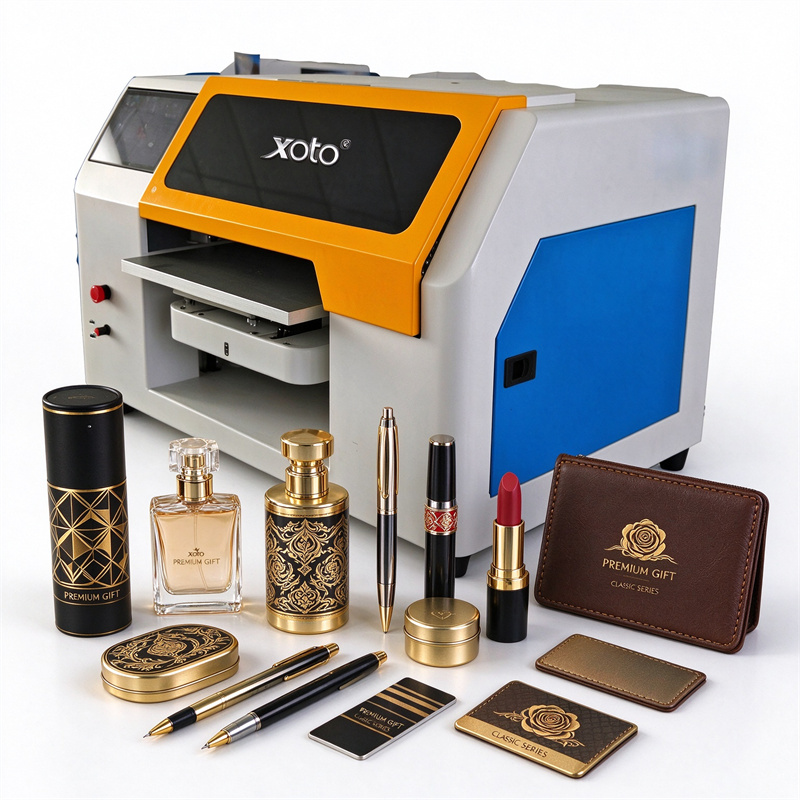
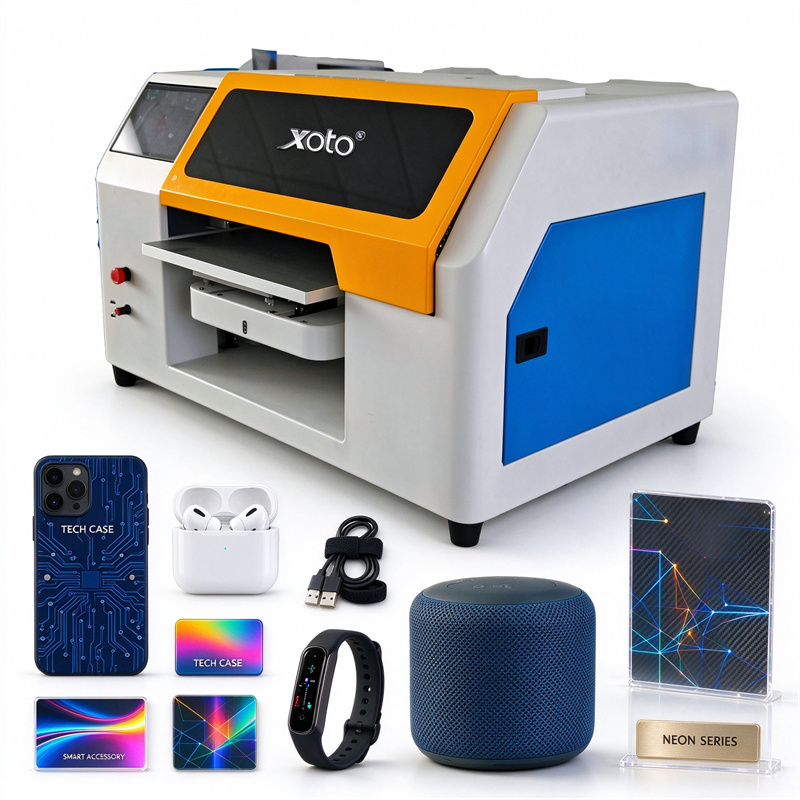
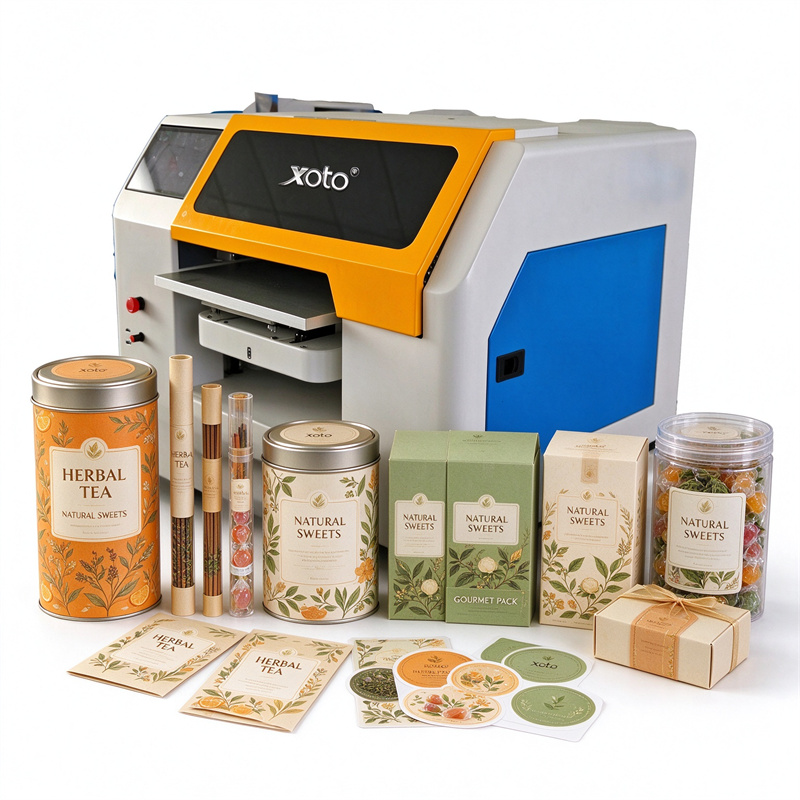
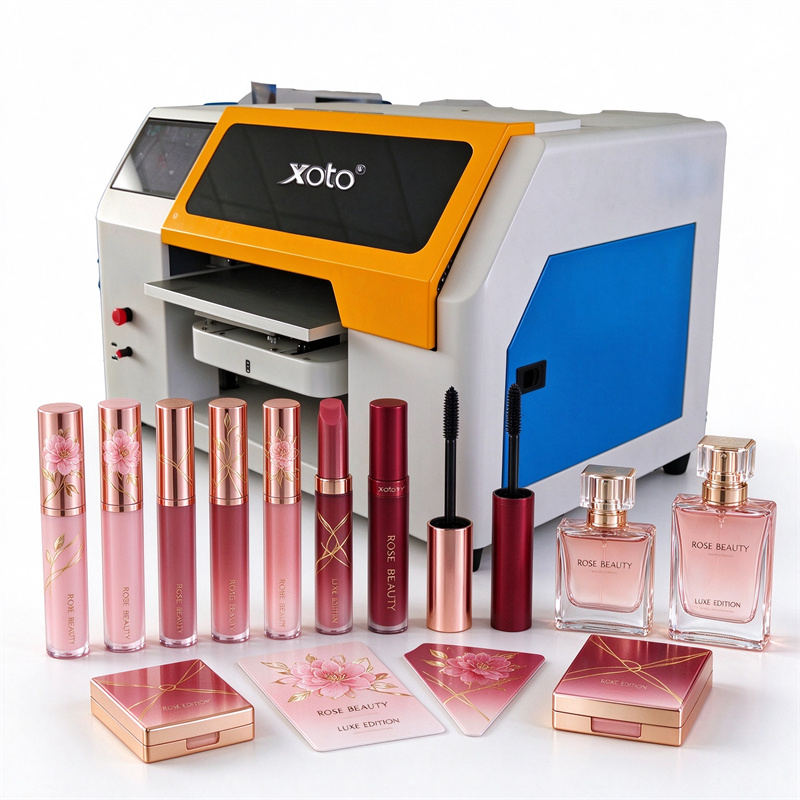
The 20 x 30 cm bed sets the honest boundary: this is a short-run, high-mix machine. It prints phone cases, coasters, plaques, badges, keychains, small boxes, glassware faces, leather patches and A4 signage panels — one piece or fifty, at the same cost per piece. It will not print a 60 x 90 cm sign, and buyers who need that should look at a floor-standing flatbed instead.
• Aluminium, acrylic, wood, leather, glass, ceramic, PVC, canvas and TPU cases — the machine prints on any flat material within the 6 cm height limit.
• White ink lays an opaque base under colour, so black phone cases, coloured packaging and clear glass all print correctly.
• Varnish builds raised texture — clear lettering, Braille-style dots, tactile logos and embossed patterns up to 6 mm.
• Optional CCD camera reads the position of each small blank before the pass, which is what makes keychains, badges and tags repeatable without a custom jig.
Scan. Pick. Print. — the Whole Workflow
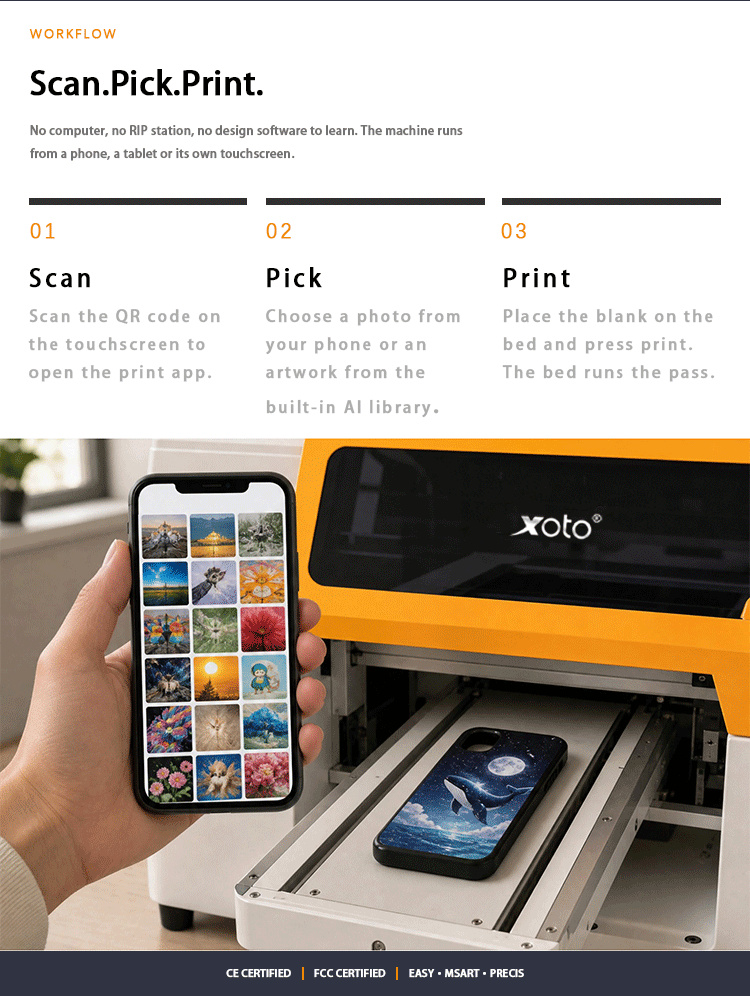
Scan the code on the touchscreen, pick artwork on your phone, place the blank and print.
1. Scan — read the QR code on the touchscreen to open the print app; no driver installation, no computer.
2. Pick — choose a photo from your phone or an image from the built-in AI artwork library, which updates in real time.
3. Print — set the blank on the bed, confirm height, press print. UV LED curing follows the head, so the piece is dry when it comes out.
This is the practical difference between a Chinese UV printer built for shops and one built for technicians: the operator never sees a RIP dialog, and a new staff member is productive on day one.
Feature Detail
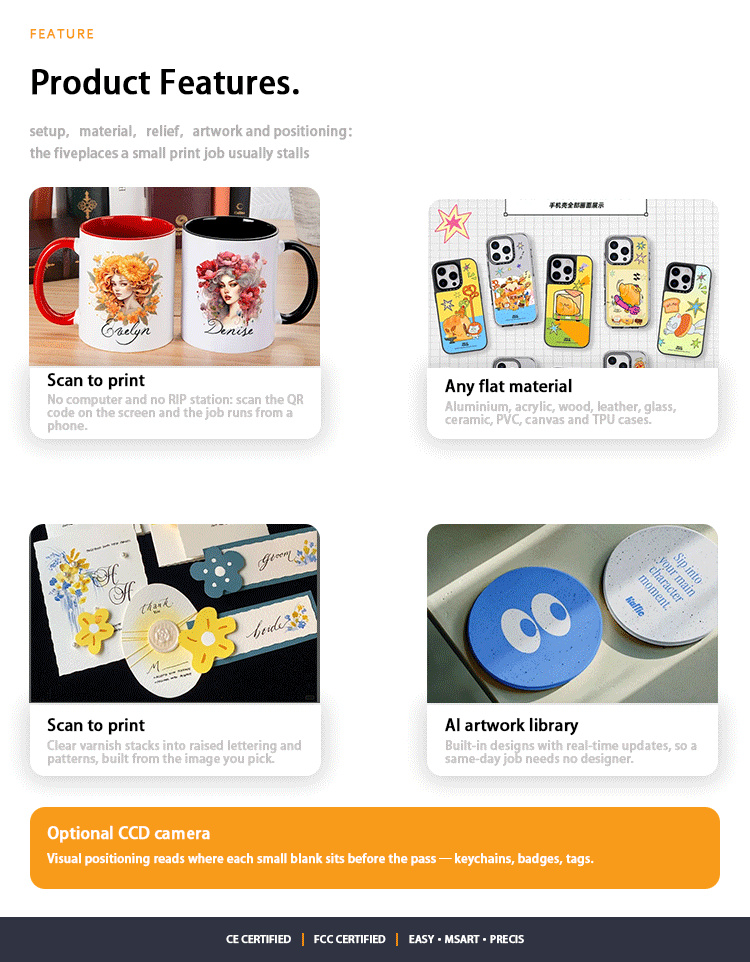
Scan-to-print control, wide material compatibility, clear varnish build-up and a built-in AI artwork library.
• Touchscreen control with front-loading bed — you load from the front, so the machine can sit against a wall in a small shop.
• Auto cleaning and a suction platform — the two features that decide whether a small UV printer stays reliable week after week.
• Emergency stop on the front panel, plus a USB port for offline jobs.
• AI artwork library with real-time updates — a same-day job does not need a designer.
• Clear varnish stacking — raised lettering and patterns built directly from the image you pick.
Dimensions, Power and Compliance
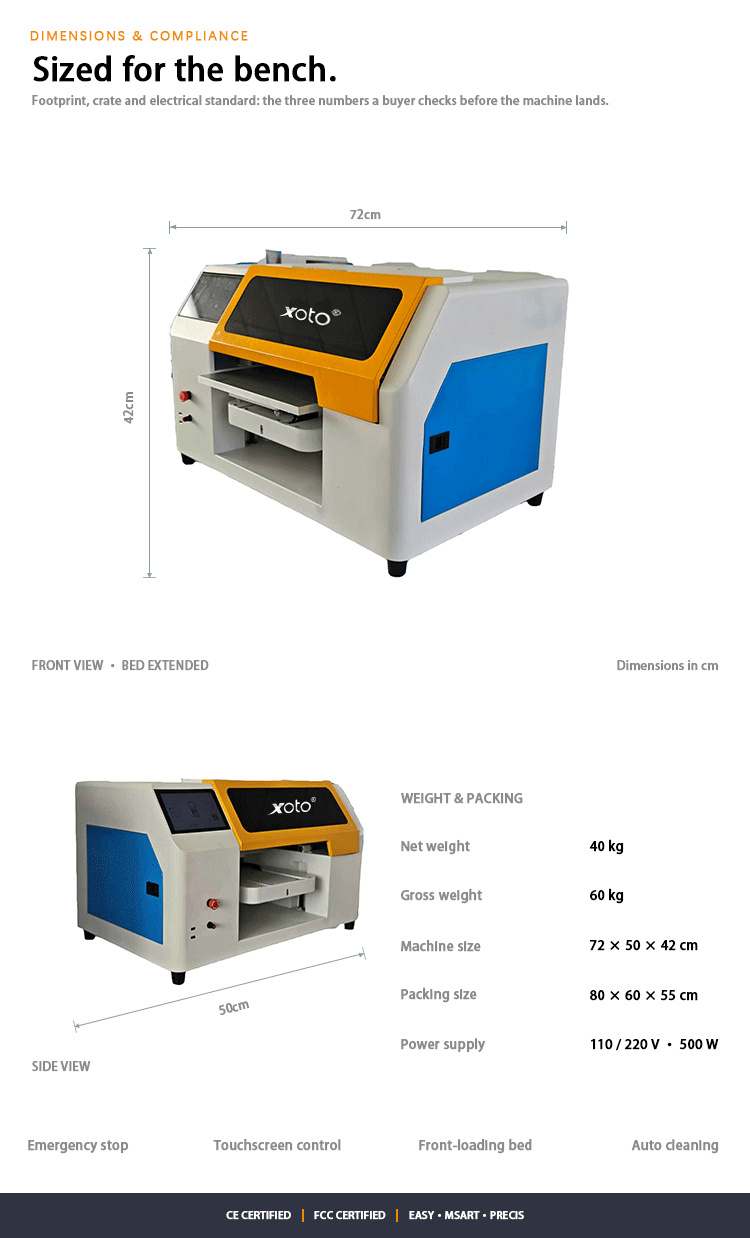
72 x 50 x 42 cm with the bed extended, 42 cm tall — it fits on a bench, not a factory floor.
| Item | Detail |
| Machine size | 72 x 50 x 42 cm (front view, bed extended); 50 cm deep in side view |
| Net / gross weight | 40 kg / 60 kg |
| Packing | One crate, 80 x 60 x 55 cm — air freight or LCL friendly |
| Power supply | 110 / 220 V, 50–60 Hz, 500 W — runs on a standard wall socket |
| Certification | CE, FCC |
| Footprint need | Bench or counter with front clearance for the bed and rear clearance for maintenance |
| Environment | Stable room temperature, low dust, level surface |
Because the electrical standard is selectable at order and the crate is under one cubic meter, a Chinese UV printer at this size clears most of the friction that stops first-time importers: no container, no three-phase supply, no rigging, and certification paperwork included.
Five Checks Before You Buy Any Chinese UV Printer
This section is the reason many buyers bookmark the page. Every point below is a question worth asking any supplier, including us.
1. Printhead authenticity — ask which exact Epson head is fitted (DX7 or i3200HD here) and how it is warrantied. A refurbished head is the most common hidden downgrade in this category.
2. Ink supply continuity — confirm the ink is a standard, repeatable SKU and that the supplier will still stock it in two years. Cheap proprietary ink is a lock-in, not a saving.
3. Spare parts list — capping station, wipers, dampers and ink tubing should be orderable as line items, with prices, before you pay.
4. Remote support in your language — ask for a live video call during installation, not just a PDF.
5. Certification documents — CE and FCC certificates should be supplied as files, with the model number matching the machine on the crate.
Service and Spare Parts
• Pre-sales sample printing — send artwork and your blank type; we print on an A4 unit and ship the sample.
• Remote setup and training by video call, in English, plus a written manual.
• Consumables and spares — printheads, capping station, wipers, dampers, UV ink and cleaning fluid.
• Warranty and after-sales terms confirmed in the sales contract before payment.
• Export documentation — commercial invoice, packing list and certification files prepared for your broker.
FAQ
1. What is a Chinese UV printer, and why do buyers search for it?
A: The term is used for UV flatbed printers manufactured in China and sold directly by the factory rather than through a local distributor. Buyers search it because the price gap is large and the machines are now mature. The XOTO A4 unit is a typical example: 20 x 30 cm bed, 0–6 cm height, Epson DX7 / i3200HD head, CMYK + white + varnish, CE and FCC certified, 40 kg net.
2. Is a Chinese UV printer reliable enough for daily commercial work?
A: At this size, yes — provided the printhead is genuine, the ink supply is stable and the maintenance routine is followed. The failure modes on cheap UV printers are almost always a refurbished head, contaminated ink or a neglected capping station, not the chassis. That is why we publish the head model, the ink type and the spare parts list instead of hiding them.
3. What can I print on a 20 x 30 cm bed?
A: Phone cases, coasters, plaques, badges, keychains, small gift boxes, glass and ceramic faces, leather patches, acrylic blocks and A4 signage panels. Anything flat within 6 cm of thickness fits. If your product is larger than A4, you need a bigger platform — this machine is deliberately sized for high-mix, short-run work.
4. How thick an object can it print?
A: Up to 6 cm, adjustable from zero. That covers mugs, power banks, small boxes and assembled items without changing a jig. Measure your tallest product before ordering — height is the specification buyers most often get wrong on a small UV printer.
5. Does it need a computer or RIP software?
A: No. The machine runs from its touchscreen or from a phone: scan the QR code, pick artwork, print. A RIP-style layout application (Wellprint) is included for jobs that need precise placement or multiple copies, and it runs on Windows, macOS, Linux, iOS and Android.
6. What is the white ink for?
A: White is an opaque base layer. Without it, CMYK ink on a black phone case or clear glass looks muddy or invisible. With white underneath, colour reads correctly on dark, transparent and metallic substrates — which is most of the gift and accessory market this machine serves.
7. What does the varnish do?
A: Varnish adds a clear layer that can be built up to roughly 6 mm of raised relief. In practice that means tactile logos, embossed lettering, Braille-style dots and textured patterns — a feature buyers pay extra for, and one of the few ways a small print shop can differentiate on finish rather than price.
8. How fast does it print?
A: 2–4 m²/h depending on pass mode and coverage. On a 20 x 30 cm bed that translates to a few minutes per full-bed pass, which is why the machine suits per-piece customisation and short runs rather than panel volume production.
9. What are the shipping and power requirements?
A: One crate at 80 x 60 x 55 cm, 60 kg gross, so it ships by air express or LCL without a container. It runs on 110 V or 220 V single phase at 500 W — a normal wall socket, no three-phase supply and no dedicated circuit.
10. Which certifications come with it?
A: CE and FCC. Ask any supplier for the certificate files with the model number matching the machine; a certificate for a different model is not a substitute, and customs brokers do check.
11. How long does setup take?
A: Most buyers are printing within a day. Unpack, level the machine, install ink, run the first cleans, then a nozzle check and an alignment print. We walk through it on a video call so the first print is not the first surprise.
12. What should I print first to test the machine?
A: Three jobs: a full-bed layout of phone cases (tests flatness and repeatability), a dark case with white underneath (tests white opacity), and a varnish build-up (tests relief height and adhesion). If those three pass, the machine matches the work you sell.
Request a Sample and a Factory Quote
Send one artwork file and tell us what you want to print — phone cases, coasters, mugs, badges or gift boxes. We print it on an A4 Chinese UV printer, photograph the result on your blank type, and send the sample with a factory quote and the full spare parts price list.